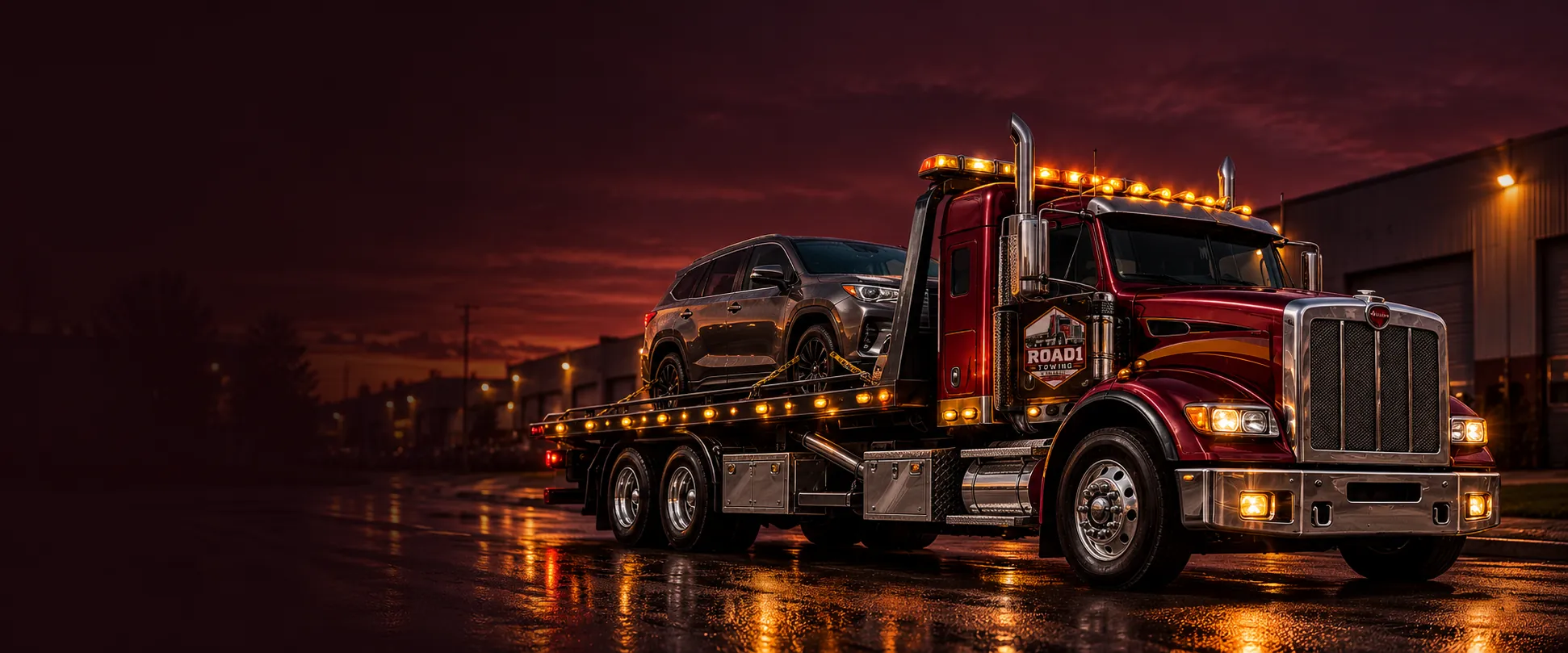
- Half-ton, three-quarter-ton and one-ton pickups, plus cargo and trades vans.
- 4x4 and AWD trucks ride on the flatbed with all four wheels off the road.
- Tell us about lift kits, oversized tires, racks, ladders or a loaded box.
- Pickups from driveways, jobsites and business lots across East Cambie.
- The price is confirmed on the phone before hook-up.
Which trucks does truck towing in East Cambie cover?
Our truck towing is built for the vehicles that sit between a car and a commercial rig: half-ton pickups, three-quarter and one-ton trucks, crew cabs with long boxes, cargo vans and the high-roof vans that trades crews drive around Richmond. They are heavier and longer than a sedan, so they get a flatbed with the deck length and rating to carry them properly. For a sedan or a crossover, car towing in East Cambie is the better fit, and a box truck or anything bigger goes to medium duty towing.
When you call, tell us the year, make and model, whether it is two-wheel or four-wheel drive, and what is in the box or the cargo area. A three-quarter-ton diesel with a full load of tile is a different weight from an empty half-ton, and knowing it up front means the right truck shows up the first time.
- Year, make, model and drivetrain (2WD, 4x4 or AWD).
- Any lift kit, levelling kit or oversized tires.
- Racks, ladders, toolboxes or a canopy on top.
- What is loaded in the box or the van, and roughly how heavy.
Why 4x4 and lifted trucks go on a flatbed
A four-wheel-drive pickup has its front and rear axles tied together through the transfer case, and dragging it with two wheels on the road can damage the drivetrain. That is why every 4x4 and AWD truck we move rides on the flatbed with all four tires on the deck. The same goes for a truck with a damaged wheel, a seized brake or a broken axle: off the road completely, chained at the right points, and nothing turning on the way. If it has gone off the shoulder first, a winch out brings it back onto firm ground before we load.
Lifted trucks need a little more planning. A tall suspension and big tires raise the centre of gravity, and some lifted trucks sit high enough that the load angle and overall height on the deck matter. Tell us how much lift and what tire size it runs, and we set the deck angle and tie-down points to suit. Lowered trucks are the opposite problem, and the same flatbed handles them with a gentle loading angle.
Dually trucks with dual rear wheels are wider at the back than most pickups, and they need the full width of the deck and tie-downs that clear both rear tires. Long-box crew cabs and trucks pulling a hitch-mounted carrier also take more deck length. Tell us about any of these on the call, along with anything hanging off the back, such as a hitch, a bike rack or a tailgate step, and we plan the load so nothing touches the deck or the road. If the truck was towing a camper or a utility trailer when it quit, trailer towing can move the trailer on the same booking.
Work trucks and trades vans in Jacombs and Crestwood
East Cambie has plenty of small business units, and a lot of the trucks we move belong to trades crews: plumbers, electricians, landscapers and contractors who park a van or a pickup at a unit off Jacombs Road or in the Crestwood industrial estate. When one of those won't start in the morning, the day's jobs stop with it. We load it where it sits without blocking other units, and we take it to your fleet shop, a dealer or your own mechanic. For those pockets, see truck towing in Jacombs and truck towing in Crestwood.
Before we arrive, secure what you can. Lock the toolboxes, tie down or remove loose material in the box, and take anything valuable out of the cab. A ladder rack can stay on, but we need to know about it so the truck sits right on the deck. If the van only has a dead battery, ask about a jump start first, and if it is a flat on a work van, mobile tire service may get it rolling without a tow.
Truck towing routes and weight limits around Richmond
A pickup on the back of a flatbed adds up to a heavy combined vehicle, and Richmond posts load limits on some of its roads. The City's commercial vehicle restrictions map shows the 5 tonne, 9 tonne and 11.8 tonne load limits, the 30 km/h zones and the height clearances, including 4.2 m at the Oak Street Bridge on Bridgeport Road. We check our route against it, so a loaded tow leaving East Cambie stays on the roads it is allowed to use.
For longer drops across Metro Vancouver, the TransLink Truck Route Planner lets commercial drivers enter their vehicle size and see suggested routes based on municipal bylaws, height clearances and bridge load limits. It is a pre-trip tool, not live navigation, and we use that kind of planning before a run out of Richmond. If the truck is headed further than the Lower Mainland, long distance towing is priced the same way, before we load.
Driveway truck towing in California Pointe and Bargen
Not every truck call is a work truck. Families in California Pointe and around Bargen Drive drive pickups and big SUVs too, and the calls from those streets are usually calm ones: a truck that won't start after a cold night, one that needs to go to the dealer for a recall, or a project truck that has not moved in a while. We park so neighbours can still get in and out, load from the driveway when it is long enough, and from the street when it is not. See truck towing in California Pointe and truck towing in Bargen for those streets.
A truck that has been parked for months often has flat tires or seized brakes, and we bring the gear to load it anyway. If you have decided it is not worth fixing, scrap truck and van removal may be the better call. Everything we offer in the neighbourhood is on our East Cambie towing homepage, and you can send us the details if you would rather write than call.